
Are Designers Reinventing Research?
Recently I’ve heard people claim that there is such thing as old research, and new research. One of the occasions on which I heard such a thing was a seminar named with all the possible buzzwords combined in one title “New Trends and Tools in Customer Experience Design and Innovation: Happy Customers and Profitable Business”. During this half-day seminar organized by the Hong Kong Design Centre (HKDC), both someone from HKDC and the main speaker, from the UK “service design” consultancy Live | Work, presented a slide similar to this:
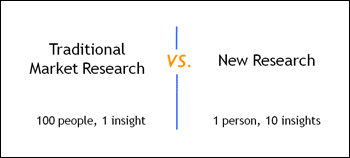
What they explained is that with traditional market research, you can research 100 people and get at best only one single insight that could lead to a design idea, while with some so-called “new” methods some people claim to use, you only need to research a few people to get loads of juicy insights that can lead to great innovation.
Not true
I would like to say that this is completely misleading and false. Perhaps some people are new to research, but the main research methods used by consultancies are not new. More specifically, I refer to observational research which is one of the most popular methods used in design research.
Observational research has been used regularly in marketing research since at least the 80’s, and ethnography in sociological research for much longer. This is a qualitative research method aimed at observing people most of the time in their natural environment. And like any research method, it has established protocols and must follow professional and ethical codes. Believing that this is new does not relieve those who intent to practice research from having to observe these rules.
Different research methods are appropriate for gathering different types of data. Sure, quantitative research methods like surveys don’t generally yield the type of insights needed to find innovation opportunity. But finding the appropriate method, or combination thereof, to answer a specific question still requires an understanding of the different types of research available and what each one is best used for.
Traditional market research agencies don’t generally conduct qualitative research that leads to innovation opportunities, and don’t provide design or strategy consulting. That is not their business. But that doesn’t mean that design, design strategy or customer experience consultancies can start conducting research without the appropriate research expertise and experience.
So the real question is not about traditional market research versus new research, but about what type of information is being sought, which methods are best suited to find it, how the information is interpreted and what is done with it.
That said, there are different types of research not used much traditionally in market research, such as projective techniques and variations of psychoanalysis, but these are not limited in their application to design or customer experience research. They are simply a means of getting deeper insights, whether about political views or the perception of package design.
Tagged: | Design, Design Research, Market Research, Research

David Jacques is Founder and Principal Consultant of Customer input Ltd and a pioneer in the field of Customer Experience Management. He has created the first Framework that brings together cohesively every aspect of Customer Experience Management. He is also passionate about having an in-depth understanding customer values to create emotionally-engaging customer experiences not only at individual interactions but also seamlessly between them.
All posts by David (30) - Connect on: LinkedIn - Twitter

Leave a Reply